How to Read a University Marksheet: Credits, Grades, SGPA and CGPA
Read a marksheet in three passes: identify the programme and regulation, understand each course row, then check the semester and cumulative summaries. A high average does not by itself confirm that every required paper is passed.
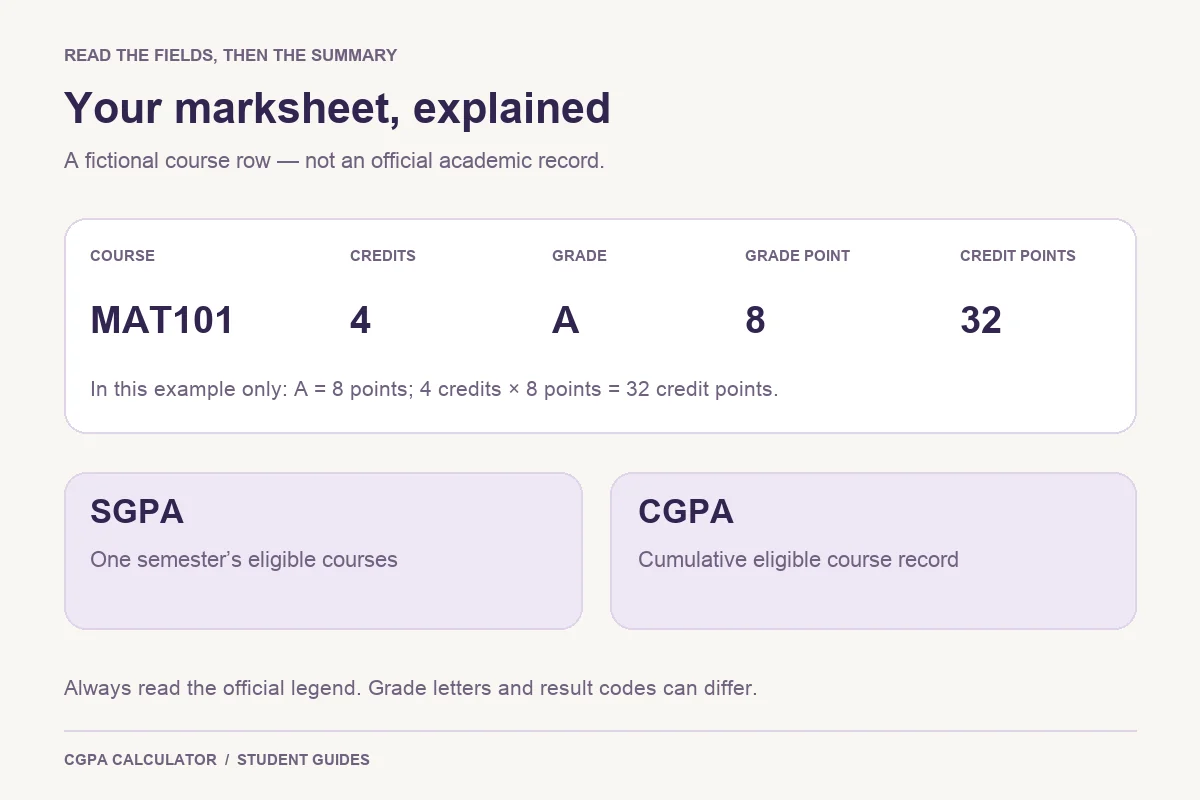
Check the document heading before the numbers
Confirm your name, registration or roll number, programme, semester, examination session and result status. Look for the regulation, scheme or admission-year reference. Keep that reference when searching for a grading table or a percentage-conversion formula.
Find the legend on the same page or reverse side. A grade sheet, statement of marks, provisional result and consolidated transcript may show different details. Use the document requested by the receiving organisation rather than assuming that a calculator export can replace it.
What the common columns mean
The University of Delhi’s October 18, 2019 CBCS notification describes grade certificates containing the course code, paper title, credits and grade, with semester and cumulative averages. That is a documented CBCS example, not a claim that every marksheet uses the same layout or current scheme.
| Field | How to read it | What not to assume |
|---|---|---|
| Course code and title | Identify the exact paper and attempt | Similar titles are not necessarily the same course |
| Credits | The course weight under the scheme | Not the marks obtained |
| Marks | Assessment score against a stated maximum | Not automatically a grade point |
| Letter grade | A category such as A or B+ | Its numeric value varies by scale |
| Grade point | The numeric value assigned to a grade | Not necessarily marks divided by ten |
| Credit points | Often credits multiplied by grade points | Check the legend before calculating |
| SGPA / CGPA | Semester / cumulative average | Neither alone confirms all degree conditions |
Official reference: University of Delhi: October 18, 2019 CBCS ordinance notification, printed page 34 (grade-certificate fields)
Read one course row: a fictional example
Imagine the row MAT101 — Mathematics I — 4 credits — grade A — 8 grade points. If the institution defines credit points as credits × grade points, that course contributes 4 × 8 = 32 credit points. The grade A has been assigned 8 only for this example; copy the mapping from your own official grade table.
If your sheet shows separate internal, external, theory or practical marks, keep those components distinct. The course may have separate passing conditions. Adding them into an overall percentage cannot establish a pass unless the applicable rules allow that interpretation.
Estimate the final-exam marks needed for a target using your assessment weights. The tool does not decide whether separate theory, practical or minimum-pass conditions have been met.
Distinguish SGPA from CGPA
SGPA summarises the eligible courses in one semester. CGPA combines the eligible course record across the cumulative period. A semester result of 9.00 can sit alongside a cumulative result of 7.80 without a contradiction: the two figures summarise different sets of credits.
To check the arithmetic, multiply each included course’s credits by its grade points, sum those products, then divide by the included credits. Check retake and failure rules first. Do not average semester GPAs equally when their included credits differ.
Check your grade points and credits in the CGPA calculator after matching the official scale and course-inclusion rule.
Decode result abbreviations using the official legend
On the University of Delhi School of Open Learning statement-of-marks page, ER means Essential Repeat, RL indicates a result to be declared later if necessary, and Imp means Improvement. Its legend also uses TH for Theory, PR for Practical, IA for Internal Assessment and A for Absent. These meanings belong to that published legend.
This is why a symbol should not be guessed: A may be a letter grade on one document and an absence code on another. Check whether a status is provisional, whether another result is pending and whether a required paper remains uncleared. Ask the examination office when the legend does not settle the question.
Official reference: University of Delhi, School of Open Learning: statement-of-marks legend
Convert to percentage only after matching the rule
First establish whether the application asks for semester GPA, final CGPA, actual aggregate marks or a converted percentage. Then find the official conversion rule that applies to your programme and cohort. Do not choose a multiplier merely because another student or a search result uses it.
Our conversion guidance and university pages identify the scope of the rules they show. A PDF or image downloaded from a calculator is a calculation report; it is not an official equivalence certificate or a university-issued transcript.
What to do when a detail looks wrong
Compare the course code, credits, attempt and grade with the records available through your official student portal. Save a copy of the result and note the date you found the discrepancy. Contact the examination office using the published correction or revaluation process; deadlines and evidence requirements vary.
For a calculation question, prepare a small table of eligible courses, credits and numeric points. For an identity or missing-result issue, provide the details the university requests through its official channel. Avoid posting an unredacted marksheet publicly: names, roll numbers, QR codes and other identifiers may be visible.
Marksheet questions
Is a grade point the same as a percentage?
No. A grade point is a value on the institution’s grading scale. Percentage conversion needs a separate applicable rule.
Does a high CGPA mean every paper is passed?
No. Check outstanding course requirements and result codes separately from the average. The university determines degree eligibility.
Can I use this illustration as a sample university marksheet?
It is only a fictional reading aid. It has no university seal, student identity, certification or official standing.
Try the cgpa calculator
Enter your own values below, or open the full cgpa calculator page for its complete usage guide.
Official examples used for this reading guide
Reviewed on October 29, 2026.
Worked examples use simplified calculation models. Check your institution’s current regulations, grading scale, rounding rules and official records before relying on a result.