How Backlogs and Retakes Affect CGPA: Rules and Worked Examples
There is no single backlog formula for every university. The effect depends on whether the failed attempt enters CGPA, which grade is counted after a retake, and how the course credits are treated. Establish those rules before calculating an expected improvement.
Check three rules before calculating
A backlog usually describes an uncleared course, but the official result code and required action come from your institution. A repeat after failure, an improvement attempt after passing, a supplementary examination and revaluation are different processes. Permission for one does not establish permission for another.
- Before clearance: does the failed course contribute zero points with its credits, or is it excluded from the cumulative average?
- After clearance: is the counted grade the best, latest, capped or otherwise specified grade?
- Credit treatment: does the course count once, and are SGPA and CGPA calculated from the same set of eligible attempts?
An official example: IIIT-Delhi B.Tech., May 2024
The May 2024 IIIT-Delhi B.Tech. regulations make a distinction that generic calculators can miss. Section 6.6 states that F is included in SGPA but excluded from CGPA. In section 6.5, a permitted repeat for improvement of an already passed course uses the best grade for CGPA, while the attempts remain on semester transcripts.
These are scoped examples from that named document. They do not mean that all universities exclude failures, that every student may repeat a passed course, or that later amendments cannot apply. Confirm the regulation and amendments covering your programme and admission batch before using either rule.
Official reference: IIIT-Delhi: B.Tech. Regulations, May 2024, sections 6.5–6.6 (repeat improvement and performance indicators)
Model 1: a failed course is included as zero
This invented ten-point example assumes a university counts the failed attempt as zero until clearance and then replaces it with the approved retake grade. It is a calculation model, not the IIIT-Delhi failure rule described above.
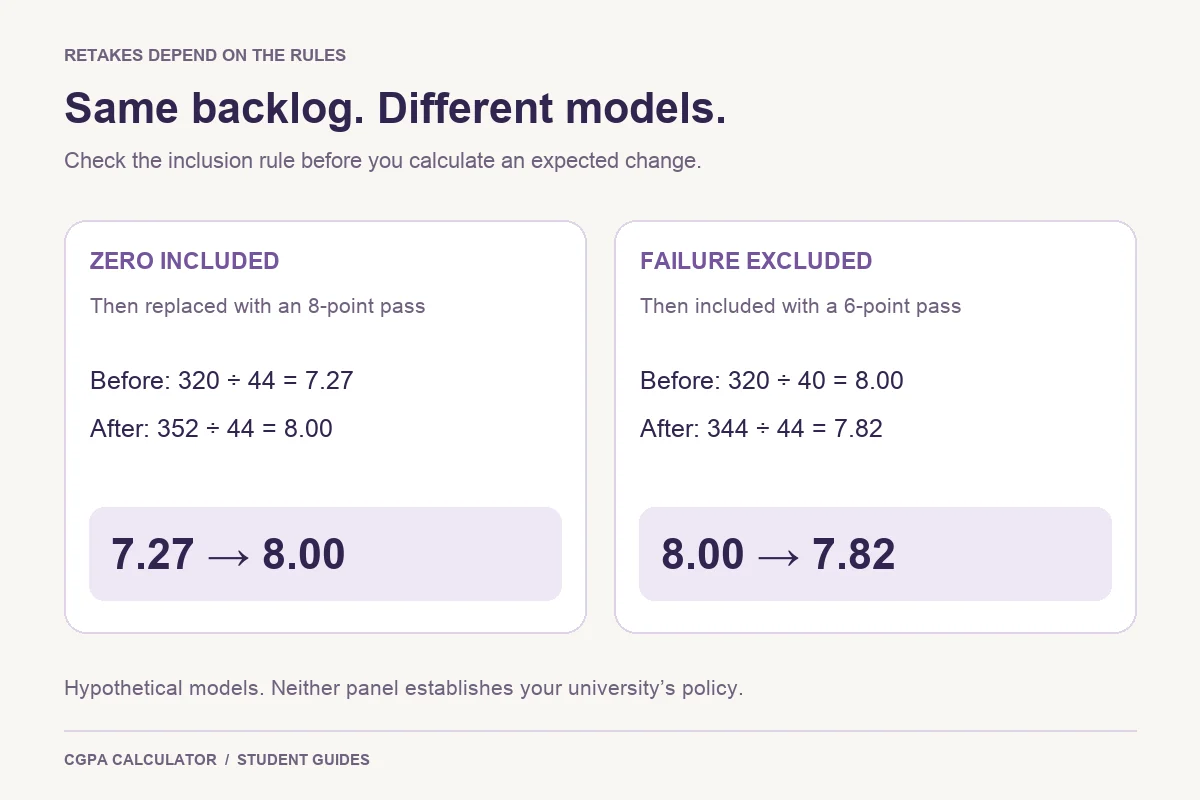
Suppose your other included courses contribute 320 weighted points over 40 credits. A four-credit backlog at zero points contributes no points but adds four credits. Before clearance the average is 320 ÷ 44 = 7.272727…, or 7.27. If the approved replacement is 8 points, the course contributes 32 points and the new average is 352 ÷ 44 = 8.00.
| Stage | Weighted points | Included credits | Average |
|---|---|---|---|
| Before clearance | 320 + 0 | 40 + 4 | 7.27 |
| After replacement at 8 | 320 + 32 | 40 + 4 | 8.00 |
Under a one-course replacement model: new CGPA = (old weighted points − credits × old counted points + credits × new counted points) ÷ unchanged included credits.
Model 2: the failure is excluded from CGPA
Now change the assumption: the failed course is omitted from the cumulative calculation until it has an eligible passing grade. The same other courses give 320 ÷ 40 = 8.00 before clearance. After the four-credit course earns an eligible 6 points, the result is (320 + 24) ÷ 44 = 7.818181…, or 7.82.
The displayed cumulative average falls in this model even though a course has been cleared. That is mathematically possible because a newly included grade below the old average pulls the average down. It does not mean clearing a backlog is harmful or optional: course completion and degree eligibility are separate requirements.
| Stage | Weighted points | Included credits | Average |
|---|---|---|---|
| Before clearance | 320 | 40 | 8.00 |
| After including the pass | 320 + 24 | 40 + 4 | 7.82 |
Improving an already passed grade
Assume a policy allows an improvement attempt and counts the better grade once. A student has 420 weighted points across 60 included credits, including a four-credit course at 5 points. Replacing that counted grade with 8 adds 4 × (8 − 5) = 12 points. The new result is 432 ÷ 60 = 7.20, compared with 7.00 before the change.
Do not add another four credits in this replacement model. Do not assume a lower repeat score will be ignored unless the applicable rule says the better grade is retained. Check attempt limits, eligibility, deadlines, caps and transcript recording with the examination office.
Use the calculator without silently changing the policy
Our general CGPA calculator counts an entered F as zero and includes its entered credits. It has no automatic retake-replacement or university-specific exclusion setting. For a replacement scenario, reconstruct the eligible course list and edit the counted grade in the existing course row; do not add the same course again as though it were a new credit award.
If a prior CGPA already contains the failed course, entering that CGPA and then adding the retake as a new subject can double-count credits. Use complete eligible course records for the before-and-after comparison. Where the official rule cannot be represented by the tool, use the university’s result or ask its examination office rather than treating a generic output as authoritative.
Compare an eligible course list in the CGPA calculator using only the grading scale and inclusion model you have confirmed.
Plan the work after confirming the rules
List the papers still to clear, their exam dates and the material that needs study. Build a realistic revision plan around those dates. Academic planning is more useful when it separates the work needed to pass from a hoped-for change in the cumulative number.
For a future target, use the Target CGPA Planner only after your existing points and eligible credits have been corrected for the applicable repeat policy. It projects future credits; it does not itself replace old attempts. Exported PDFs, images and print reports are planning records, not evidence that a backlog has officially been cleared.
Backlog and retake questions
Explore a future CGPA target after correcting your starting record
Does clearing a backlog always increase CGPA?
No. In a zero-inclusion replacement model a higher counted grade increases the average. In an exclusion model, adding a passing grade below the previous average can lower it. The official inclusion rule decides which calculation applies.
Will the old attempt disappear from my transcript?
Not necessarily. A rule may retain attempts on the transcript while using only one grade for CGPA. Check the official transcript policy separately.
Can I use semester GPA and credits to recalculate everything?
Only if the semester averages use the same eligible-course basis as CGPA. A scheme that handles failures differently in SGPA and CGPA requires more detailed records.
Can the target planner predict my official result after a retake?
It cannot apply a retake policy automatically. First establish the corrected current average and eligible credits from the official rules and course record.
Try the cgpa calculator
Enter your own values below, or open the full cgpa calculator page for its complete usage guide.
Official retake example and its programme scope
Reviewed on October 29, 2026.
Worked examples use simplified calculation models. Check your institution’s current regulations, grading scale, rounding rules and official records before relying on a result.