How to Prioritise an Unfinished Syllabus Before Exams
When the syllabus is unfinished, the next useful step is a decision about work, not a more flattering progress percentage. Combine your coverage record with exam scope and available time.
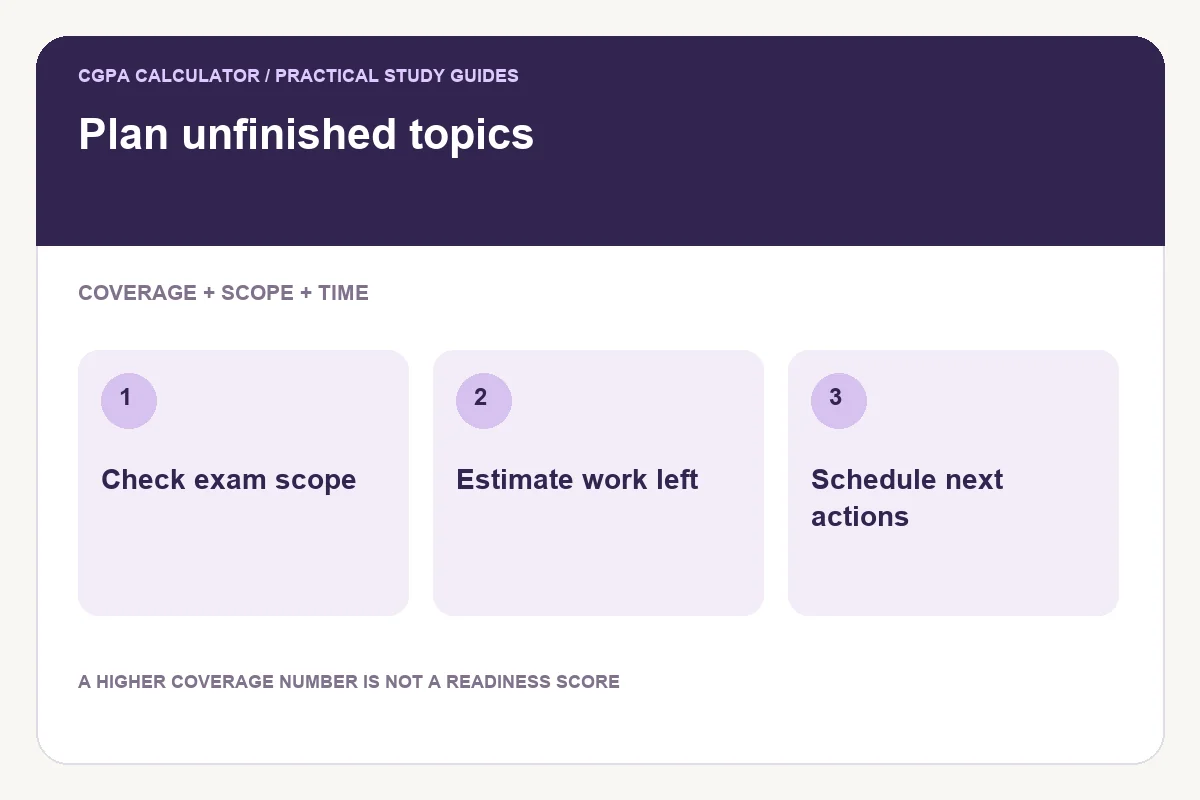
Check what is actually assessed
Start with the announced exam scope and format. A topic’s position in a textbook does not tell you whether it is excluded from an assessment or how it may be tested. Use current instructor guidance rather than an unofficial prediction of likely questions.
Identify dependencies too. A later topic may depend on an earlier method you have not understood. The progress tracker records coverage; it cannot discover those relationships for you.
Estimate remaining work separately from coverage
A topic marked 50% complete is not necessarily halfway through its remaining study time. The unfinished portion may be more difficult, or the completed portion may still need practice. Estimate the next actions and their minutes rather than deriving study time mechanically from the percentage.
Keep your weighting basis stable. If weights represent relative study size, do not suddenly change them to exam importance just to create a priority list. Record assessment importance separately in your planning notes.
Compare two topics without chasing the total
Suppose Topic A has weight 4 and progress 75%, while Topic B has weight 1 and progress 0%. Weighted coverage is (4×75 +1×0) ÷5 =60%. Finishing B would raise coverage to 80%, but that alone does not prove B deserves the next available hour.
The decision also depends on assessment scope, dependencies, your ability to answer questions and the work needed. The tracker’s arithmetic should describe your plan, not make the judgement for you.
(4 × 75 + 1 × 0) ÷ 5 = 60% recorded coverage
Turn the decision into a schedule
Choose the next tasks, estimate their remaining minutes and attach the relevant exam date in the revision planner. Check the visible unallocated workload. If the work does not fit, revise the plan openly rather than assuming it will be completed after the exam.
The planner uses earlier exam dates first and priority to break equal-date ties. It does not automatically rank topics by examination importance or infer a priority from syllabus weights.
Use practice to reassess the priorities
Attempt a representative question without notes after studying a topic. Check the answer and record what still needs work. This can reveal a gap that a high coverage percentage would otherwise conceal.
Once the workload fits, place the sessions in the weekly timetable around real commitments. Keep some flexibility for tasks that run longer than expected. Save locally and export the current version so you can see the reasoning behind the schedule.
Common questions
Should I always finish the smallest topic first?
Not automatically. Consider assessment scope, prerequisites, your current understanding and the work required.
Does weighted progress rank topics for me?
No. It summarises the coverage values and weights you enter. Prioritisation requires information beyond that percentage.
Try the syllabus progress tracker
Enter your own values below, or open the full syllabus progress tracker page for its complete usage guide.
Further reading
Reviewed on October 24, 2026.
Worked examples use simplified calculation models. Check your institution’s current regulations, grading scale, rounding rules and official records before relying on a result.