YCMOU Science CGPA to Percentage: The 2026 Formula Explained
For the grading system documented in YCMOU’s School of Sciences Prospectus 2026, converting a CGPA involves both multiplication and a deduction. This guide explains the sequence and how to check that the rule fits your programme.
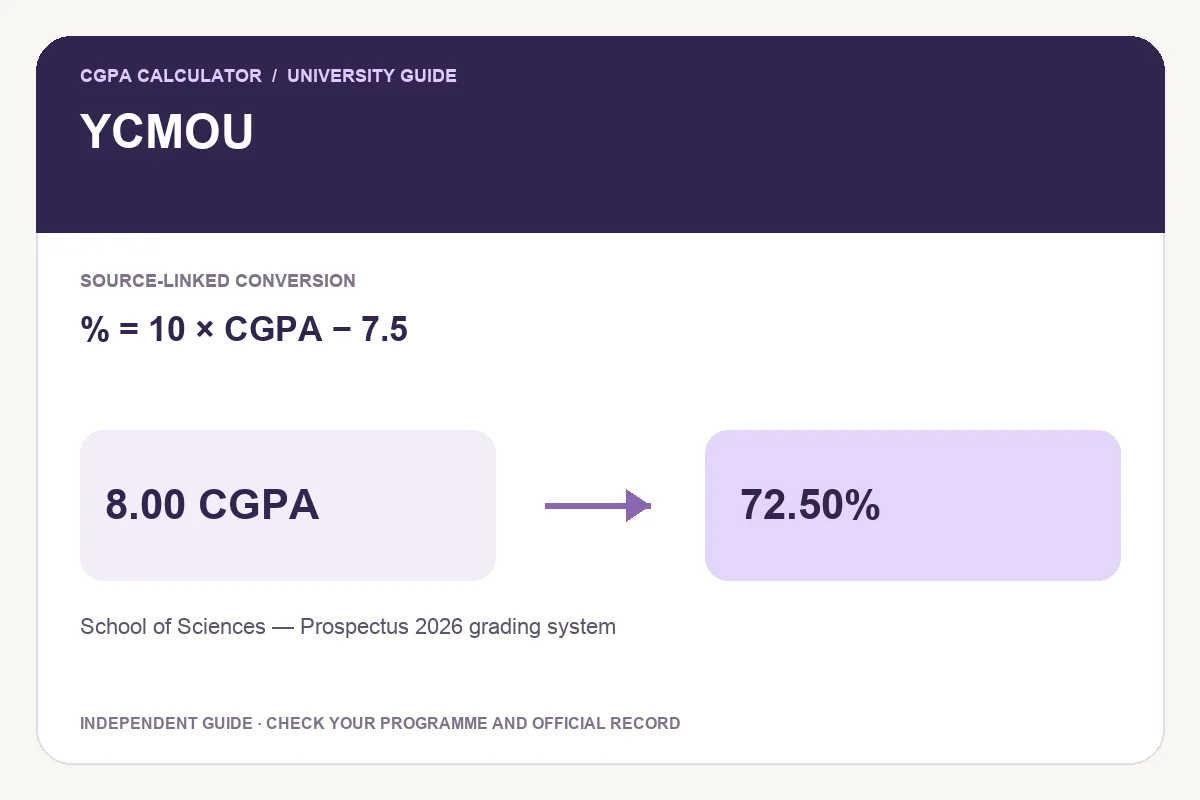
The formula printed in the 2026 prospectus
Page 27, item 8, of the official School of Sciences Prospectus 2026 states percentage equivalence = 10 × CGPA − 7.5. This is the method used by the linked calculator.
The verified scope is the grading system documented in that prospectus. Do not assume that every historical YCMOU programme, qualification or assessment pattern uses the same instruction. Check your programme’s applicable prospectus or examination guidance.
Percentage equivalence = (10 × CGPA) − 7.5
Worked example: 8.00 CGPA becomes 72.50%
First multiply 8.00 by 10 to obtain 80.00. Then subtract 7.5 percentage points: 80.00 − 7.50 = 72.50%. Parentheses help show the order clearly. Subtracting before multiplying would produce a different, incorrect calculation.
| CGPA | Calculation | Percentage equivalence |
|---|---|---|
| 6.00 | 60.00 − 7.50 | 52.50% |
| 7.00 | 70.00 − 7.50 | 62.50% |
| 8.00 | 80.00 − 7.50 | 72.50% |
| 9.00 | 90.00 − 7.50 | 82.50% |
How to check your input and calculate
- Identify the school, programme and academic pattern on your record.
- Review page 27 of the linked 2026 School of Sciences prospectus.
- Select that prospectus’s grading-system preset in the calculator.
- Enter the final ten-point CGPA and review the resulting percentage and source before exporting.
Common mistakes when converting YCMOU grades
A marks-to-grade table groups performance into bands. A table by itself does not prove that an exact percentage can be recovered from a grade-point average. Use an explicit applicable conversion instruction rather than guessing a multiplier from the endpoints of a band.
Another common mistake is using one semester’s SGPA where a form requests the cumulative result. Read the field label and keep the original academic record available. A grade-point summary and a completed degree’s final record may cover different courses.
Keep the converted percentage attached to its programme scope. If an official record or later applicable instruction gives a different method, resolve the difference with the university before using an estimate on an application.
Save, print or share a calculation
After entering a valid grade-point value, choose Download PDF for a portable report, Print report for a paper copy, or Download image for a PNG. Keep the programme label, formula and source with the result so that the calculation can be understood later.
Share opens a preview with the tool link selected by default. Select Include current result only when you want to include the entered value and calculation details. Review the preview before copying it or choosing a sharing app. A report generated by this website is an independent calculation, not a university certificate.
Frequently asked questions
Does YCMOU always use CGPA × 10?
The cited 2026 School of Sciences prospectus instead states 10 × CGPA − 7.5. This guide verifies that scope and does not assert a university-wide rule for all historical programmes.
Is 8.00 CGPA 80% in this preset?
No. Under the documented rule, the deduction gives 72.50%. The calculator displays the selected formula with the result.
Try the programme-specific calculator
Open the full university calculator and usage guide, or use the same tool below.
Official source checked
Reviewed on October 23, 2026.
Worked examples use simplified calculation models. Check your institution’s current regulations, grading scale, rounding rules and official records before relying on a result.